
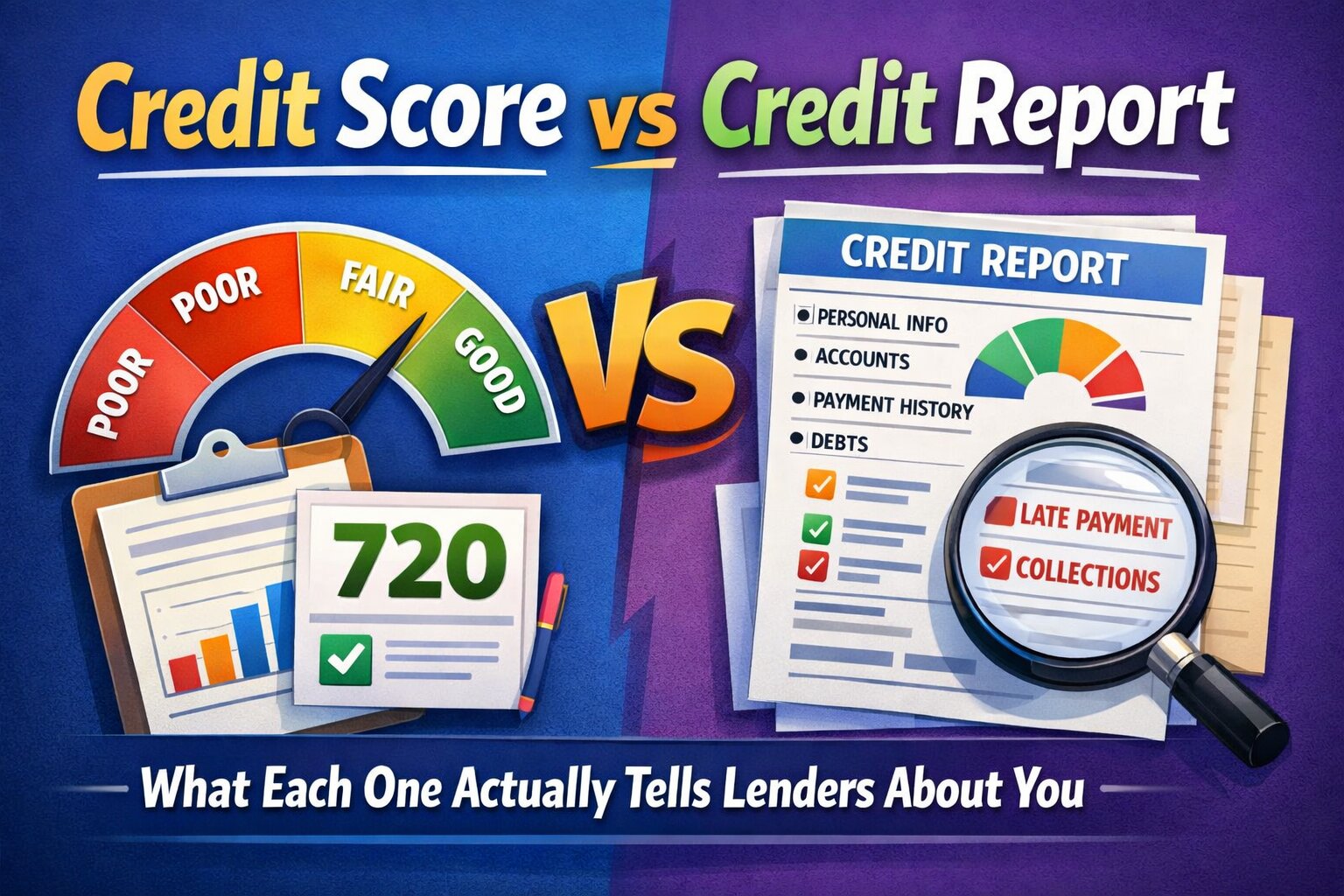
Most people use the terms credit score and credit report interchangeably, as if they are two names for the same thing. They are not. They are related but distinct pieces of your financial profile that serve different purposes, contain different information, and affect lending decisions in different ways. Confusing the two leads to real mistakes, like disputing the wrong thing when something looks off, or checking one when you should be checking the other. Understanding exactly what each one contains and what lenders actually do with that information puts you in a much stronger position to manage your credit intentionally rather than reactively.
What a Credit Report Actually Is
A credit report is a detailed historical record of how you have managed debt and financial obligations over time. It is a document, not a number. Think of it as a file that a lender opens and reads rather than a score they glance at.
Your credit report is compiled and maintained by the three major credit bureaus, Equifax, Experian, and TransUnion. Each bureau collects information independently from lenders, creditors, and public records, which is why your report at each bureau may look slightly different. Not every creditor reports to all three bureaus and timing differences mean the same account may appear with slightly different balances depending on which bureau you are looking at.
Your credit report contains several distinct sections. The personal information section includes your name, current and previous addresses, date of birth, Social Security number, and employment information as reported by creditors. This section does not affect your credit score but errors here can sometimes indicate identity theft.
The accounts section, sometimes called the tradeline section, is the most detailed part of your report. It lists every credit account associated with your name including credit cards, mortgages, auto loans, student loans, personal loans, and lines of credit. For each account it shows the creditor’s name, the account number partially masked, the type of account, the date it was opened, the credit limit or original loan amount, the current balance, the monthly payment amount, and your payment history going back up to seven years. That payment history shows every month as either paid on time, paid late with the number of days late specified, or not paid at all.
The inquiries section shows every time someone has requested your credit file. Hard inquiries occur when you apply for credit and stay on your report for two years. Soft inquiries occur when you check your own credit or when a lender pre-screens you for an offer and are not visible to other lenders.
The public records and collections section shows bankruptcies, which stay on your report for seven to ten years depending on the type, and collection accounts, which stay for seven years from the original delinquency date. Recent changes to medical debt reporting have removed most medical collections from this section as discussed later in this article.
What a Credit Score Actually Is
A credit score is a three-digit number calculated by running the information in your credit report through a mathematical model. It is a snapshot, not a history. It tells a lender in a single number how likely you are to repay a debt based on your credit behavior to date.
The most widely used scoring model is the FICO Score, developed by the Fair Isaac Corporation. FICO scores range from 300 to 850. Most lenders consider scores above 670 good, above 740 very good, and above 800 exceptional. Scores below 580 are generally considered poor and significantly limit access to credit or result in much higher interest rates.
VantageScore is the other major scoring model, developed jointly by the three credit bureaus as an alternative to FICO. VantageScore also ranges from 300 to 850 and uses similar factors, though the weighting differs from FICO in ways that sometimes produce different scores for the same person. Many free credit monitoring services show you a VantageScore rather than a FICO score, which can create confusion when the number you see for free differs from what a lender pulls when you apply for credit.
Because your score is calculated from your report, you have three FICO scores and three VantageScores at any given time, one from each bureau. These scores are often close to each other but not identical because each bureau’s version of your report contains slightly different information.
How Each Factor in Your Report Becomes Part of Your Score
The FICO scoring model weights five categories of information from your credit report to produce your score. Understanding this relationship is the key to understanding why the report and the score are related but different tools.
Payment history accounts for 35 percent of your FICO score and is drawn directly from the payment history section of your credit report. Every on-time payment strengthens this factor. Every late payment, whether 30, 60, or 90 days late, weakens it. A single missed payment on an otherwise clean report can drop your score significantly because this factor carries so much weight.
Credit utilization accounts for 30 percent of your score and measures how much of your available revolving credit you are using across all your accounts. This information comes from the current balance and credit limit fields in your tradeline section. A utilization ratio below 30 percent is generally considered healthy. Below 10 percent is better. Utilization is one of the fastest factors to improve because it responds to balance changes in near real time once your creditors report updated information to the bureaus.
Length of credit history accounts for 15 percent of your score and looks at the age of your oldest account, the age of your newest account, and the average age of all your accounts. This information is all in your report’s accounts section. Closing old accounts can hurt this factor by reducing your average account age, which is why keeping old accounts open even when you are not using them is generally advisable.
Credit mix accounts for 10 percent of your score and reflects whether you have experience managing different types of credit including revolving accounts like credit cards and installment loans like auto or student loans. Lenders want to see that you can handle more than one type of debt responsibly.
New credit accounts for 10 percent of your score and is influenced by the hard inquiries in your report. Each hard inquiry from a new credit application slightly reduces your score for up to 12 months. Multiple hard inquiries in a short period can compound this effect, though the scoring models treat multiple inquiries for the same type of loan such as mortgage shopping within a short window as a single inquiry to account for rate shopping behavior.
What Lenders Actually Do With Each One
When you apply for credit, most lenders pull your credit report and generate a credit score from it simultaneously. They use both pieces of information but for different purposes in the lending decision.
The credit score serves as a quick filter. A lender’s underwriting guidelines typically specify a minimum score threshold for each product. If your score falls below that threshold, your application may be automatically declined without a human ever reading your report. If your score meets the threshold, the application moves forward to a more detailed review.
At the detailed review stage, the lender reads your actual credit report to understand the story behind the score. Two applicants can have identical scores but very different reports. One might have a clean report with one recent late payment that temporarily dragged the score down. Another might have multiple collections, high utilization across several cards, and several recent hard inquiries. The score alone does not distinguish between these profiles. The report does.
Lenders look at specific patterns in your report that the score summarizes but does not fully explain. They look at how recently negative items occurred because a late payment from five years ago is treated very differently than one from three months ago. They look at whether negative items are isolated or part of a pattern. They look at whether the account types match the product you are applying for. A mortgage lender pays particular attention to your history with installment debt. A credit card issuer focuses more on your revolving credit history.
Employment and rental screening work differently. Employers who conduct credit checks and landlords who screen tenants look at your credit score vs report explained through a different lens than a lender does. They are generally looking for evidence of financial responsibility or red flags like collections and judgments rather than making an interest rate decision. Many employers and landlords do not pull a traditional credit score at all but look directly at the report for specific types of negative information.
Why Your Report and Score Can Tell Different Stories
There are situations where your credit report contains negative information that your score does not fully reflect, and situations where your score looks better than your report would suggest to a careful reader.
A high score with a thin report is one example. Someone with a short credit history, only one or two accounts, and perfect payment history may have a strong score relative to their history but a report that a cautious lender considers insufficient for a large loan. The score looks acceptable but the report tells the lender there is not enough history to evaluate the borrower confidently.
A moderate score with a complicated report is another. Someone who had serious financial difficulties several years ago, rebuilt steadily since, and now has a score in the high 600s may have a report that still shows old collections or a settled account. The score has recovered but the report still contains the historical record that the score alone does not communicate.
Recent changes to medical debt reporting have created situations where a report has been cleaned up in ways that improve the score but where the underlying financial situation has not changed. Knowing that medical debt under $500 was removed from reports in 2023 and that the Consumer Financial Protection Bureau has moved to limit medical debt reporting more broadly means that some reports now look cleaner than they would have two years ago. This benefits borrowers with medical debt but it is worth understanding that lenders are also aware of these changes and may ask additional questions during underwriting.
How to Get Both for Free
You have the right to a free copy of your credit report from each of the three bureaus through AnnualCreditReport.com, which is the only federally authorized source. Weekly free reports from all three bureaus remain available as of 2026, meaning you can pull a different bureau’s report each week and maintain a rotating view of your full credit file at no cost.
Free credit scores are available through several sources including Credit Karma for VantageScores from Equifax and TransUnion, Experian’s free account for your Experian FICO score, and many credit card issuers who provide free FICO scores to cardholders as a standard account benefit. Checking the back of your credit card statement or logging into your card issuer’s app often reveals a free score you already have access to without signing up for anything new.
Which One to Focus on When Something Goes Wrong
When you notice a problem with your credit, whether a score drop you did not expect or a concern that your file may contain errors, starting with your credit report rather than your score is almost always the right move. The report contains the actual information. The score is a reflection of that information. Fixing a problem in your report fixes the score automatically over time. Trying to improve your score without understanding what is in your report is like treating symptoms without identifying the cause.
If your score dropped suddenly, pull all three reports and look for the specific change that triggered it. A new collection account, a newly reported late payment, a significant balance increase, or a hard inquiry from an application you do not recognize are the most common culprits. Each of these has a specific remedy. An inaccurate item can be disputed directly through the bureau’s online portal. An accurate late payment can be addressed through a goodwill letter to the creditor. A high balance can be reduced by paying down the account. A hard inquiry from an application you did not make is a potential sign of identity theft that warrants immediate action through IdentityTheft.gov.
The Consumer Financial Protection Bureau has a free guide to understanding and disputing credit report errors that walks you through the process step by step. The process costs nothing and the bureaus are required by law to investigate disputes within 30 days of receiving them.
Your credit report and your credit score are two tools that work together but serve different purposes in the lending process. The report is your financial history written out in full detail. The score is a summary of that history expressed as a single number. Lenders use both and so should you. Checking your report regularly for accuracy, understanding what is driving your score up or down, and knowing which tool to reach for when something needs to be fixed gives you real control over your credit profile rather than leaving it as something that just happens to you over time.





Leave a Reply