
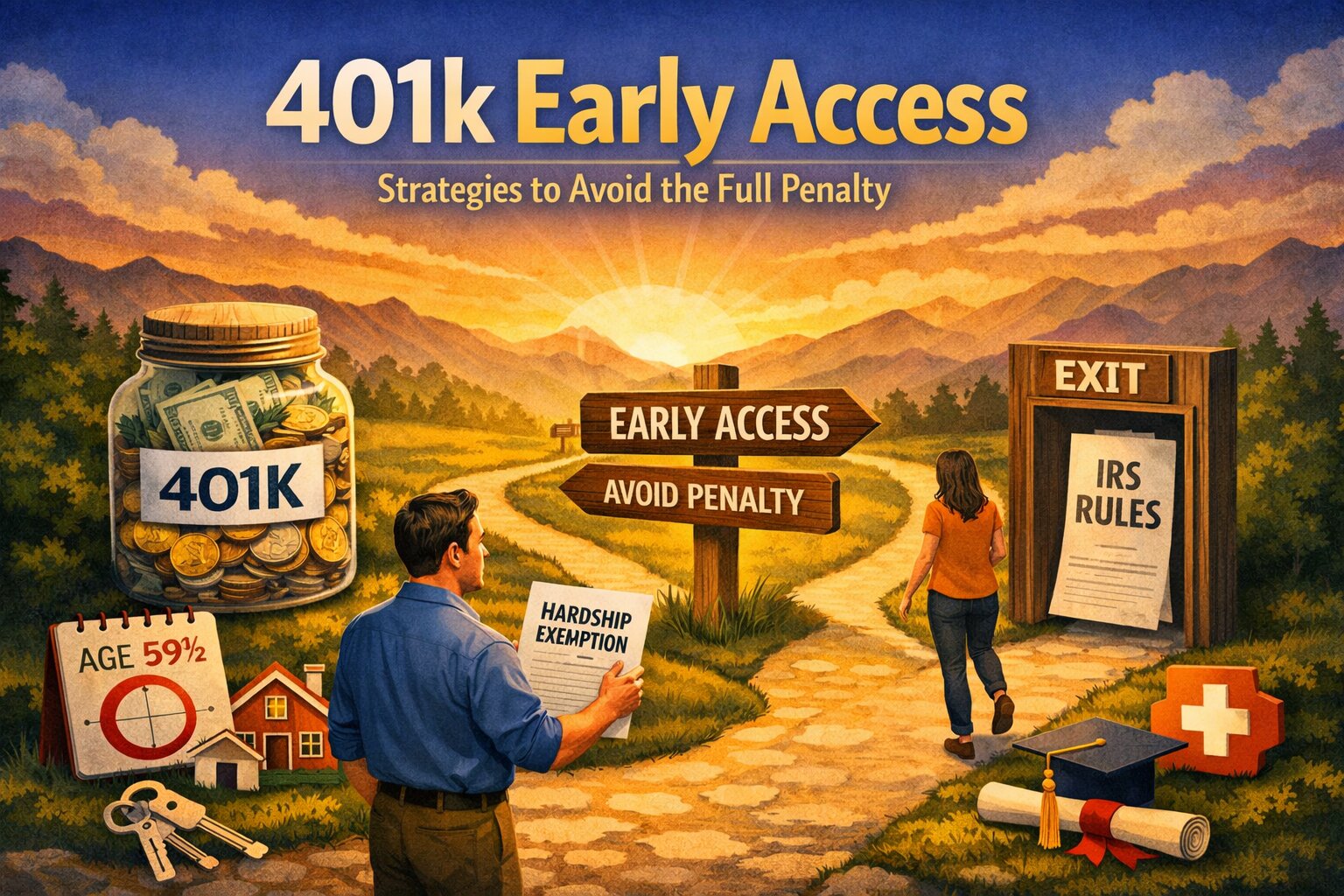
Most people know the basic rule about 401k accounts. Touch the money before age 59 and a half and you pay a 10 percent early withdrawal penalty on top of ordinary income taxes. For someone in the 22 percent federal tax bracket, that means giving up roughly 32 cents of every dollar withdrawn before they ever see it. What far fewer people know is that the tax code contains a meaningful number of exceptions to that 10 percent penalty, and several of them apply to situations that are far more common than most retirement plan participants realize. If you are facing a genuine financial hardship or a major life event and need access to your retirement savings, understanding every available option before you make a move can save you thousands of dollars.
Understanding the Difference Between a Withdrawal and a Loan
Before getting into the penalty exceptions, it helps to separate two fundamentally different ways of accessing your 401k before retirement. A withdrawal takes money out of the account permanently. You pay income taxes on the amount withdrawn in the year you take it, and you may or may not owe the 10 percent early withdrawal penalty depending on whether an exception applies. The money is gone from your retirement account and stops growing.
A 401k loan borrows money from your own account and requires you to pay it back with interest, typically within five years. The interest you pay goes back into your own account rather than to a lender. Loans do not trigger income taxes or the early withdrawal penalty as long as you repay them on schedule. If you leave your job before repaying the loan, the outstanding balance typically becomes due within a short window, and if you cannot repay it, the unpaid balance is treated as a distribution subject to taxes and the penalty.
Not every 401k plan allows loans, so checking your plan documents or contacting your plan administrator is the first step before pursuing either option.
The Rule of 55
One of the most useful and least widely known exceptions to the early withdrawal penalty is the Rule of 55. Under this provision, if you leave your job in the year you turn 55 or later, you can take withdrawals from the 401k associated with that specific employer without paying the 10 percent early withdrawal penalty. You still owe ordinary income taxes on the amount withdrawn, but the penalty does not apply.
This exception applies only to the 401k from the employer you left. It does not apply to IRAs or to 401k accounts from previous employers. If you want to take advantage of the Rule of 55, it is important not to roll the funds from your most recent employer’s plan into an IRA before you start taking distributions, because doing so eliminates your access to this exception.
For workers in public safety occupations including police officers, firefighters, and emergency medical technicians, the age threshold is lowered to 50 rather than 55. Check IRS Publication 575 for the specific requirements that apply to your situation.
Substantially Equal Periodic Payments
If you need to access your 401k before age 55 or before separating from your employer, Substantially Equal Periodic Payments, known as SEPP or the 72t method named after the IRS code section that governs it, allow you to take penalty-free withdrawals by committing to a series of payments calculated using IRS-approved methods.
The three IRS-approved calculation methods are the required minimum distribution method, the fixed amortization method, and the fixed annuitization method. Each produces a different payment amount based on your account balance, your life expectancy, and an IRS-approved interest rate. Once you begin SEPP payments you must continue them for at least five years or until you reach age 59 and a half, whichever is longer. Modifying or stopping the payments before that period ends triggers the 10 percent penalty retroactively on all distributions taken under the arrangement, plus interest.
SEPP is a powerful tool for people who need ongoing income from their retirement savings before traditional retirement age, but the commitment it requires makes it more suitable for long-term income planning than for addressing a one-time financial emergency. Working with a financial advisor or tax professional before setting up a SEPP arrangement is strongly advisable given the consequences of getting it wrong.
Hardship Withdrawals
Many 401k plans allow hardship withdrawals for participants facing specific financial emergencies. A hardship withdrawal takes money out of your account permanently but may qualify for an exception to the 10 percent penalty depending on the nature of the hardship and how your plan is structured.
The IRS defines specific qualifying hardship reasons that plans may recognize. These include medical expenses for you, your spouse, your dependents, or your primary beneficiary. They include costs directly related to the purchase of a principal residence, though not mortgage payments. They include tuition, fees, and room and board for post-secondary education for the next 12 months. They include payments necessary to prevent eviction from or foreclosure on your primary residence. They include funeral expenses and certain costs related to repairing damage to your primary home.
Qualifying for a hardship withdrawal under your plan’s rules does not automatically mean the 10 percent penalty is waived. Whether the penalty applies depends on whether the hardship fits one of the statutory penalty exceptions listed in the tax code. Medical expenses that exceed a certain threshold, for example, are a statutory exception to the penalty. Tuition expenses, by contrast, typically do not qualify as a penalty exception even if your plan allows a hardship withdrawal for education costs. Confirming with your plan administrator and a tax professional which penalty exceptions apply to your specific situation before taking the withdrawal saves you from an unexpected tax bill.
Statutory Penalty Exceptions Worth Knowing
Beyond hardship withdrawals and the Rule of 55, the tax code contains several specific situations where the 10 percent early withdrawal penalty does not apply regardless of your age.
Total and permanent disability is one of the clearest exceptions. If you become totally and permanently disabled as defined by the IRS, you can take withdrawals from your retirement account at any age without the 10 percent penalty. Documentation from a physician confirming the nature and permanence of the disability is required.
Qualified domestic relations orders, known as QDROs, allow a former spouse to receive a portion of your 401k as part of a divorce settlement without the early withdrawal penalty applying to the amount transferred to the former spouse. This exception applies to the receiving spouse’s share and requires a properly drafted QDRO approved by the plan administrator.
Unreimbursed medical expenses that exceed 7.5 percent of your adjusted gross income qualify for a penalty exception in the year the expenses occur. This does not require a hardship withdrawal from your plan. It is a statutory exception that applies to the amount of the distribution used to cover those excess medical costs.
Health insurance premiums paid while you are unemployed qualify for a penalty exception if you have received unemployment compensation for 12 consecutive weeks, the distributions are taken in the year you received unemployment compensation or the following year, and the distributions do not exceed the amount paid for health insurance premiums during that period.
IRS levies on your retirement account, active duty military service of more than 179 days, birth or adoption of a child up to $5,000 per child, and terminal illness diagnosis are additional exceptions that were expanded or added by the SECURE 2.0 Act signed into law in late 2022.
The SECURE 2.0 Emergency Withdrawal Provision
The SECURE 2.0 Act introduced a new emergency personal expense distribution provision that took effect in 2024. Under this provision, retirement plan participants can withdraw up to $1,000 per year from their 401k for unforeseeable or immediate financial needs without paying the 10 percent early early 401k withdrawal rules penalty. You still owe income taxes on the amount withdrawn.
You have three years to repay the distribution. If you repay it within that period, the income taxes paid on the distribution can be recovered through amended returns or future year adjustments. If you do not repay it, you cannot take another emergency distribution for three years. This provision is relatively new and not all plan administrators have implemented it yet, so checking with your specific plan is necessary to confirm availability.
Roth 401k Accounts Have Different Rules
If your retirement savings are in a Roth 401k rather than a traditional 401k, the rules around early access work somewhat differently. Roth 401k accounts are funded with after-tax dollars, meaning contributions have already been taxed. You have the right to withdraw your original contributions at any time without taxes or penalties because you already paid tax on that money when you put it in.
Earnings inside a Roth 401k are subject to the same early withdrawal rules as a traditional 401k. Withdrawing earnings before age 59 and a half triggers income taxes and the 10 percent penalty unless an exception applies. Keeping track of how much of your Roth 401k balance represents contributions versus earnings is important for understanding how much you can access penalty-free in an emergency.
Before You Take Any Distribution
The decision to take an early 401k distribution should always be a last resort after exhausting other options. The long-term cost of removing money from a tax-advantaged account is higher than the immediate tax and penalty bill because you also lose the future growth that money would have generated. A $10,000 withdrawal at age 45 does not just cost you $3,200 in taxes and penalties today. It also costs you the growth that $10,000 would have produced over the next 20 or more years of compounding.
Before tapping your retirement account, consider whether a 401k loan is available and makes more sense than a permanent withdrawal, whether a personal loan or home equity line of credit offers a lower overall cost, whether a hardship assistance program through a local nonprofit or government agency can address the immediate need without touching retirement savings, and whether your employer offers an emergency savings account or employee assistance program that provides short-term financial support.
The IRS Interactive Tax Assistant has a tool that walks you through whether a specific withdrawal qualifies for a penalty exception based on your answers to a series of questions. FINRA’s retirement account resource center provides plain-language explanations of the rules governing early distributions. A fee-only financial advisor or a certified public accountant can model the full after-tax cost of your specific situation and help you compare every available option before making a decision that affects your long-term financial security.





Leave a Reply