
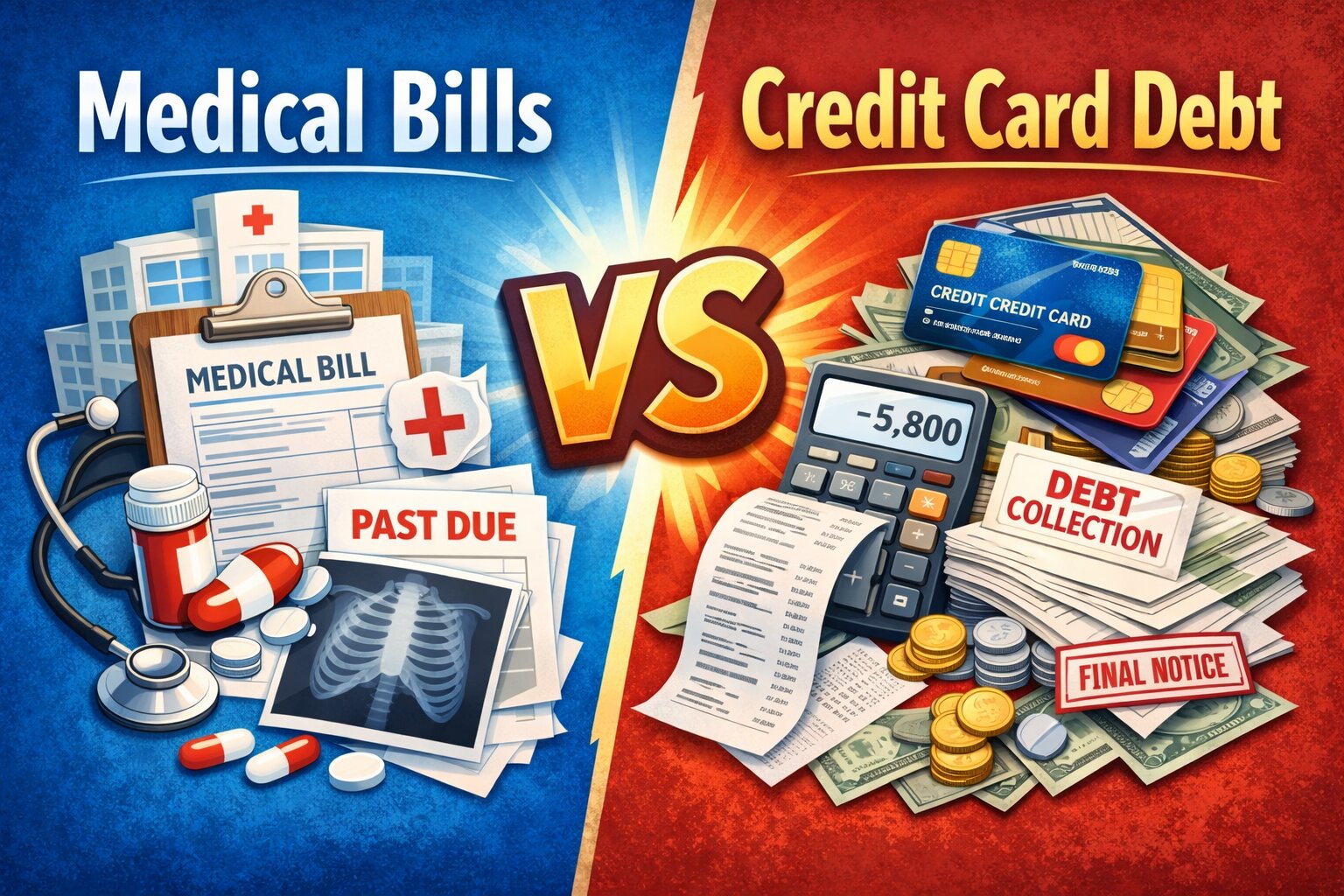
Two of the most common types of debt American households carry are medical bills and credit card balances, and when money is tight they often compete for the same limited dollars every month. Most people approach this decision based on instinct or anxiety rather than strategy, paying whichever bill feels most urgent or whichever creditor is calling most frequently. That approach costs money. The right order to pay down these two types of debt depends on several factors that are specific to your situation, and understanding those factors clearly makes the decision significantly more straightforward than it initially appears.
Why the Type of Debt Matters Before Anything Else
Medical debt and credit card debt behave very differently from a legal, financial, and credit reporting standpoint. Treating them as equivalent just because both show up as money owed is one of the most common mistakes people make when trying to manage multiple debts simultaneously.
Credit card debt is contractual debt. When you opened your credit card account you signed an agreement that specifies the interest rate, the minimum payment, the consequences of missing a payment, and the creditor’s right to report your payment behavior to the credit bureaus. That agreement is legally binding and the consequences of not meeting its terms are well-defined and immediate. A missed credit card payment is reported to the credit bureaus after 30 days, begins accruing late fees, and can trigger a penalty interest rate that significantly increases your balance going forward.
Medical debt has historically operated under a different set of norms and increasingly under a different set of rules. You did not negotiate the terms of your medical debt before receiving care in most cases. Nonprofit hospitals are required by federal law to have financial assistance programs. Medical debt under $500 was removed from credit reports by the three major bureaus in 2023 and the Consumer Financial Protection Bureau finalized a rule in 2025 removing most medical debt from credit reports entirely, though the legal status of that rule has faced ongoing challenges. Medical providers are also generally more willing to negotiate balances and set up interest-free payment plans than credit card companies.
The Interest Rate Argument
From a purely mathematical standpoint, the highest interest rate debt should be paid down first because it is costing you the most money every month it remains unpaid. This is the foundation of the debt avalanche method, which directs extra payments toward the debt with the highest interest rate while making minimum payments on everything else.
Credit card interest rates in 2026 average over 20 percent annually for new accounts according to data from the Federal Reserve. Some store cards and cards for borrowers with limited credit carry rates above 28 percent. At 20 percent interest, a $5,000 credit card balance costs roughly $1,000 per year just in interest if the balance stays flat.
Medical debt held directly with the original provider is frequently interest-free, particularly when the provider has agreed to a payment plan. A medical bill that is not accruing interest has a true cost of exactly what you owe and nothing more. Paying down interest-free medical debt before a 20 percent credit card balance means you are leaving the more expensive debt growing while you eliminate the cheaper one. The math strongly favors paying credit card debt first in most situations where the medical debt carries no interest.
The calculation shifts when medical debt has been sold to a collections agency that is now charging interest, or when a medical credit card like CareCredit was used to finance the medical expense. CareCredit and similar medical financing products often carry deferred interest provisions that trigger a large retroactive interest charge if the full balance is not paid within the promotional period. A CareCredit balance approaching its promotional deadline should be treated with the same urgency as a high-interest credit card because that is effectively what it becomes the moment the promotional period ends.
The Credit Score Argument
Credit card payment history has a direct and immediate impact on your credit score. Payment history is the single largest factor in your FICO score, accounting for roughly 35 percent of the total. A credit card payment that is 30 days late appears on your credit report immediately and can drop your score by a significant number of points depending on where your score was before the missed payment.
Medical debt’s relationship with your credit score has changed substantially in recent years. As mentioned earlier, the major credit bureaus removed medical debt under $500 from credit reports in 2023 and extended the reporting grace period for larger medical debts to 12 months before they can appear as collections. The CFPB’s 2025 rule went further by attempting to remove most medical debt from credit scoring entirely, though you should verify the current status of that rule through the CFPB website because its implementation has been subject to legal challenges.
The practical implication is that prioritizing credit card payments to protect your credit score is a stronger argument now than it was five years ago, because the credit score consequences of falling behind on medical debt are lower than they used to be while the consequences of missing credit card payments remain immediate and significant.
The Collections Risk Argument
Both medical debt and credit card debt can be sent to collections, but the timeline and consequences differ in ways that affect the priority decision.
Credit card debt can be sent to a collections agency relatively quickly after default, sometimes within three to six months depending on the creditor. Once in collections, the debt may be resold multiple times and the collections activity, phone calls, letters, and potential lawsuits becomes more aggressive. Credit card companies and their collections partners are also more likely to pursue legal action and seek wage garnishment than medical providers in most states.
Medical providers typically have longer timelines before sending accounts to collections and are more willing to work out payment arrangements that prevent the account from going to a third party at all. Calling the billing department and requesting a payment plan before a bill becomes severely overdue is a reliable way to keep medical debt from reaching collections. Most nonprofit hospitals are required to offer financial assistance and payment plan options as a condition of their tax-exempt status under IRS requirements.
When Medical Debt Should Come First
There are specific situations where prioritizing medical debt makes more sense than the general guidance above would suggest.
If your medical debt is with a provider who does not offer payment plans and is threatening to send the account to collections imminently, preventing that outcome may be worth redirecting funds that would otherwise go toward credit card debt. A collections account on your credit report, even with the new CFPB protections limiting medical debt reporting, creates complications that can take years to fully resolve.
If the medical debt is for ongoing care you need to continue receiving, maintaining your relationship with that provider by keeping the account current ensures you retain access to care. A provider who has written off your balance and sent it to collections is unlikely to continue treating you, which has health consequences beyond the financial ones.
If the medical debt is large enough that it qualifies for financial assistance or charity care at a nonprofit hospital, pursuing that application aggressively takes priority over paying either debt. Reducing or eliminating the medical balance through financial assistance fundamentally changes the repayment math in your favor.
The Debt Priority Decision Guide Framework
Working through a few specific questions about your situation gives you a clearer picture of where to direct your money.
Does your medical debt carry interest? If yes, compare the rate to your credit card rate and pay the higher rate first. If no, prioritize the credit card debt because it is costing you more every month.
Is either debt at immediate risk of going to collections? If your credit card is approaching default, the credit score damage from a missed payment argues for making at least the minimum payment first. If medical debt is being threatened with immediate collections action, a phone call to the billing department to arrange a payment plan often costs nothing and buys significant time.
Do you qualify for financial assistance on the medical debt? Applying for charity care or a hardship program at a nonprofit hospital before making any payments is worth the time it takes. Paying down a balance you might qualify to have reduced or forgiven entirely is a poor use of limited funds.
Is the medical debt on a medical credit card with a deferred interest deadline approaching? Treat it like a high-interest credit card and prioritize it accordingly.
Negotiating Both Debts Simultaneously
One practical approach that many people overlook is negotiating both debts at the same time rather than waiting to address one after the other. Medical billing departments respond well to proactive contact and direct requests for reduced balances or interest-free payment plans. Many hospitals will settle a medical balance for less than the full amount when the alternative is the account going uncollected or being sold to a collections agency.
Credit card companies also negotiate more often than most cardholders realize. Hardship programs that temporarily reduce your interest rate, waive fees, or lower your minimum payment are available through most major issuers and are worth requesting directly if your financial situation has changed. Call the number on the back of your card and ask specifically whether a hardship program is available. Getting your credit card interest rate reduced even temporarily while you work through a difficult financial period changes the math significantly on how long it takes to pay down the balance.
Organizations like the National Foundation for Credit Counseling provide free or low-cost debt counseling through nonprofit member agencies. A certified credit counselor can review your full debt picture, help you prioritize payments strategically, and potentially enroll you in a debt management plan that negotiates lower interest rates with your credit card issuers on your behalf. The Patient Advocate Foundation offers similar free case management for medical debt specifically, helping patients navigate financial assistance applications and negotiate directly with providers.
The Minimum Payment Rule Applies to Both
Regardless of which debt you prioritize with extra payments, making at least the minimum payment on every account every month is non-negotiable from a credit score and collections prevention standpoint. The extra dollars above the minimums are what you direct strategically based on the factors above.
Missing a minimum payment on a credit card to make a larger payment on a medical bill is almost never the right trade because the credit score damage from the missed credit card payment outweighs the benefit of the extra medical debt payment in most scenarios. Keeping every account current with at least the minimum while directing extra funds strategically is the foundation of any effective debt repayment plan.





Leave a Reply